

TMS Therapy for OCD in Frisco, TX
TMS therapy for OCD in Frisco, TX, offers patients a non-invasive treatment option designed to help manage obsessive thoughts and compulsive behaviors. At Frisco Quick Care, Dr. Jehangir W. Gowani, MD, FACP, FAAP, and the experienced team provide personalized TMS care in a supportive medical setting. Each treatment plan is tailored to the patient’s symptoms, health history, and individual goals, helping ensure safe and focused care. For more information, contact us or schedule an appointment online. We are conveniently located at 8845 Gary Burns Dr, Ste 180, Frisco, TX 75034.
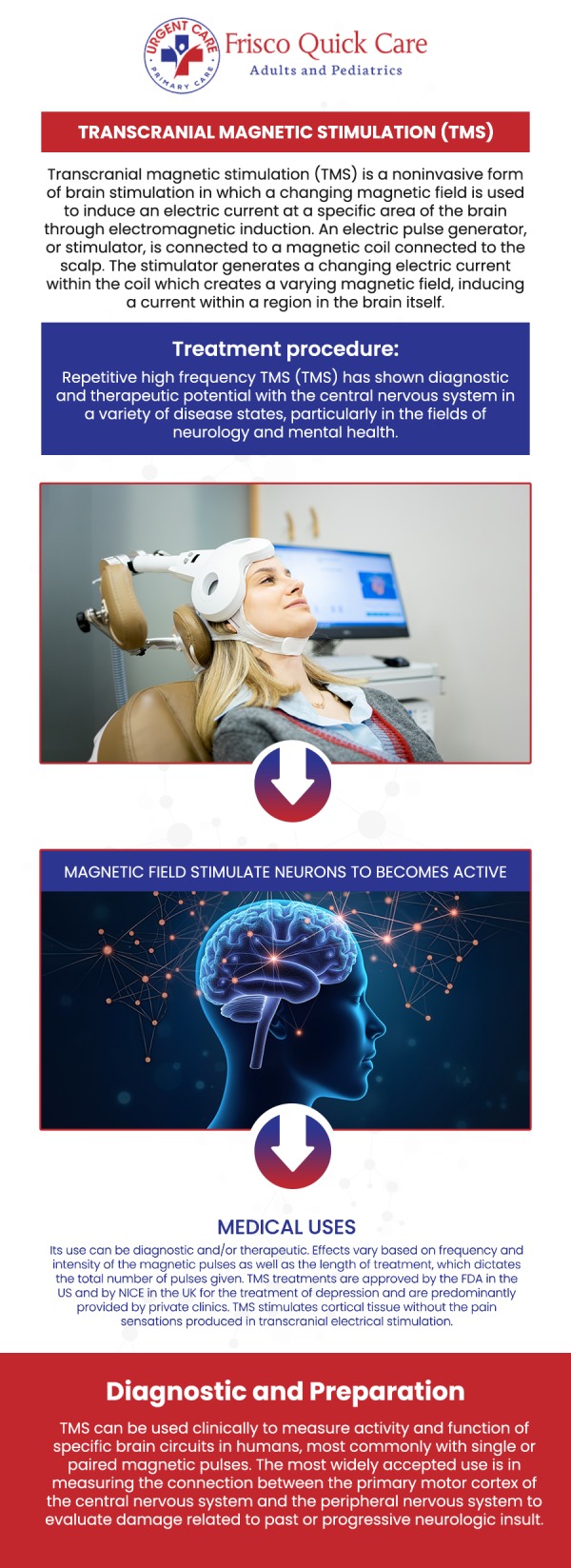
Table of Contents:
What is TMS therapy for OCD?
How does TMS therapy help with obsessive-compulsive disorder?
Who is a good candidate for TMS therapy for OCD?
How long does it take to notice results from TMS therapy for OCD?
Board-Certified Dr. Jehangir W. Gowani and the Team Provide TMS Therapy for OCD in Frisco, TX
TMS therapy for OCD, also called transcranial magnetic stimulation, is a noninvasive treatment that uses magnetic pulses to stimulate specific areas of the brain involved in obsessive thoughts and compulsive behaviors. For OCD, repetitive TMS may be used when symptoms are severe or when standard treatments have not provided enough relief.
During treatment, a magnetic coil is placed near the scalp while the patient remains awake. The pulses help regulate overactive brain circuits linked to OCD, to reduce the intensity of obsessions and compulsions over time. TMS does not involve surgery or anesthesia, and it is usually performed as a series of sessions over several weeks under the guidance of a trained mental health provider.
If you or a loved one is living with OCD and finding current treatments ineffective, TMS therapy at Frisco Quick Care may be an option to consider. Our experienced medical team will assess your medical history and unique needs to determine if TMS is an appropriate choice for you.
Obsessive-Compulsive Disorder (OCD) can be an exhausting condition, especially when standard treatments like medication or cognitive behavioral therapy fall short. Transcranial Magnetic Stimulation (TMS)—specifically Deep TMS (dTMS)—offers an alternative by directly targeting the physical brain circuitry responsible for your symptoms.
Here is exactly how it works:
• Targeting the Hyperactive Circuit
In people with OCD, a specific brain network called the Cortico-Striato-Thalamo-Cortical (CSTC) circuit is hyperactive. This overactivity causes the brain to get “stuck” in a loop of intrusive thoughts and repetitive compulsions.
TMS uses a specialized electromagnetic helmet to deliver focused magnetic pulses to the dorsomedial prefrontal cortex (dmPFC) and the anterior cingulate cortex (ACC), which are the key hubs of this hyperactive network.
• Modulating Brain Activity
These magnetic pulses induce tiny electrical currents that help normalize communication within the CSTC pathway. Over time, repeated sessions encourage neuroplasticity—effectively “rewiring” the brain so it no longer defaults to the obsessive-compulsive loop.
• Symptom Provocation
Right before the magnetic pulses begin, a provider will intentionally activate your OCD using a tailored trigger. Activating this specific circuitry makes those precise neural pathways more vulnerable and receptive to the stimulation.
• The Outcome
FDA-cleared for OCD, TMS is a non-invasive, outpatient treatment. While it physically calms the overactive brain, it is most effective when combined with ongoing therapy, making the behavioral changes required for long-term relief much easier to achieve.
Choose TMS at Frisco Quick Care for a non-invasive and well-tolerated treatment option that does not require anesthesia and is not associated with systemic side effects. Our experienced clinicians provide personalized care by tailoring each treatment plan to your unique needs, symptoms, and goals. With a convenient location, Frisco Quick Care makes TMS therapy easily accessible for patients in Frisco and surrounding communities.
Navigating OCD treatments can be frustrating when standard approaches fail. Transcranial Magnetic Stimulation (TMS) is a specialized, “second-line” treatment recommended for specific situations rather than as a first attempt at managing the disorder. Here is a breakdown of who makes a good candidate.
The Ideal Candidate
• Treatment-Resistant OCD: You have tried standard first-line treatments without sufficient success. This usually means completing adequate trials of SSRI medications and Cognitive Behavioral Therapy (CBT)—specifically Exposure and Response Prevention (ERP).
• Moderate to Severe Symptoms: Your OCD symptoms significantly disrupt your daily life, relationships, and overall functioning despite previous treatment efforts.
• Age: FDA-cleared Deep TMS for OCD is designated for adults, typically between the ages of 22 and 68.
• Willingness for Provocation: You must be willing to briefly engage with your specific triggers (symptom provocation) right before each session to intentionally activate the OCD brain network.
• Time Commitment: You have the flexibility to attend daily outpatient sessions, usually 5 days a week, for about 6 weeks.
Who Should Avoid It
Because TMS uses powerful magnetic fields, it interacts with metals and brain activity, making it unsafe for certain individuals:
• Metal Implants: Aneurysm clips, deep brain stimulators, or magnetic dental implants in or near the head. (Standard dental fillings are perfectly safe.
• Seizure History: TMS carries a small risk of inducing seizures, generally disqualifying those with epilepsy.
• Implanted Devices: Electronic devices like pacemakers or vagus nerve stimulators.
• Co-occurring Conditions: Severe neurological issues, active substance abuse, or psychosis.
Our compassionate team at Frisco Quick Care is committed to helping you find the most effective treatment for your mental health needs.
Waiting for a new treatment to work can be stressful, but with TMS for OCD, patience is essential. It is a very gradual process, not an overnight fix. Here is the typical timeline for noticing results:
The Typical Timeline
• Weeks 1 to 3 (The Building Phase): During the first few weeks of daily sessions, it is normal to feel no change in your OCD symptoms. You might experience minor, temporary side effects like mild scalp discomfort, but obsessions and compulsions typically remain at their baseline.
• Weeks 4 to 6 (Subtle Shifts): Most patients begin noticing improvements in this window. Changes are rarely sudden. You might notice the volume of your intrusive thoughts has turned down slightly, or you experience a small window of hesitation, making it easier to resist compulsions.
• After Treatment (Continued Healing): Because TMS relies on neuroplasticity by physically building healthier neural connections, healing continues after your last session. Many find that their symptoms keep improving for weeks or months afterward
Dr. Jehangir W. Gowani, MD, FACP, FAAP, is board-certified in internal medicine and pediatrics, with additional certification in sleep medicine. At Frisco Quick Care, Dr. Gowani and the team provide TMS therapy for OCD in Frisco, TX, with a patient-centered approach focused on safety, comfort, and individualized care. TMS therapy is a non-invasive treatment that uses targeted magnetic pulses to stimulate areas of the brain involved in obsessive thoughts and compulsive behaviors. Dr. Gowani carefully evaluates each patient’s symptoms, medical history, and treatment goals to determine whether TMS may be an appropriate option.
At Frisco Quick Care, patients receive supportive guidance throughout the TMS therapy process, from the initial consultation to ongoing treatment sessions. Dr. Gowani and the team create personalized care plans designed to help reduce OCD symptoms and improve daily functioning. With experienced medical oversight and a convenient Frisco, TX location, Frisco Quick Care helps patients explore advanced, non-medication treatment options in a professional and compassionate setting.
For more information, contact us or schedule an appointment online. We are conveniently located at 8845 Gary Burns Dr, Ste 180, Frisco, TX 75034. We serve patients from Frisco TX, Little Elm TX, Prosper TX, The Colony TX, McKinney TX, Hunters Glen, TX, and surrounding areas.

Check Out Our 5 Star Reviews


Additional Services You May Need
▸ Abrasions
▸ ADHD Evaluation and Treatment for Adults
▸ ADHD Evaluation and Treatment for Pediatric
▸ Allergies
▸ Annual Physical Exam
▸ Arthritis
▸ Asthma
▸ Behavioral Health Services
▸ Bronchiolitis
▸ Cholesterol
▸ Chronic Pain
▸ Covid-19
▸ CPAP Titration
▸ Dermatology Services
▸ Diabetes
▸ Ear Infection
▸ Eye Infection
▸ Flu Treatment
▸ Flu Shot
▸ General Vision Test
▸ Exomind Therapy
▸ Hypertension
▸ Hypothyroidism
▸ Influenza
▸ Insomnia
▸ Laboratory Testing
▸ Medical Weight Loss
▸ Minor Cuts
▸ Minor Fractures
▸ Minor Gastrointestinal Illness
▸ Minor Injury Treatment
▸ Mononucleosis
▸ Mounjaro
▸ Obesity
▸ Ozempic
▸ Pediatrics Care
▸ Pink Eye
▸ Polysomnography
▸ Phentermine Oral Tablets
▸ Pre Op Physical
▸ Rashes and Dermatitis
▸ Respiratory Syncytial Virus
▸ Sinusitis
▸ Sleep Apnea
▸ Sleep Disorders
▸ Sports Injuries
▸ Sports Physicals
▸ Sprains and Strains
▸ Std Testing
▸ Strep Throat
▸ Throat Infection
▸ Telehealth
▸ TMS Therapy for Depression
▸ TMS Therapy for Excessive Eating
▸ TMS Therapy for Anxiety
▸ TMS Therapy for OCD
▸ Urgent Care
▸ Urinary Tract Infection
▸ Vaccinations
▸ Weight Management
▸ Wegovy
▸ Walk-In Medical Care
▸ Zepbound

Additional Services You May Need
▸ Abrasions
▸ Allergies
▸ Annual Physical Exam
▸ Arthritis
▸ Asthma
▸ Behavioral Health Services
▸ Bronchiolitis
▸ Cholesterol
▸ Chronic Pain
▸ Covid-19
▸ CPAP Titration
▸ Dermatology Services
▸ Diabetes
▸ Throat Infection
▸ Ear Infection
▸ Eye Infection
▸ Flu Treatment
▸ Flu Shot
▸ General Vision Test
▸ Hypertension
▸ Hypertension
▸ Hypothyroidism
▸ Influenza
▸ Insomnia
▸ Laboratory Testing
▸ Medical Weight Loss
▸ Minor Cuts
▸ Minor Fractures
▸ Minor Gastrointestinal Illness
▸ Minor Injury Treatment
▸ Mononucleosis
▸ Mounjaro
▸ Obesity
▸ Ozempic
▸ Pediatrics Care
▸ Pink Eye
▸ Polysomnography
▸ Phentermine Oral Tablets
▸ Pre Op Physical
▸ Rashes and Dermatitis
▸ Respiratory Syncytial Virus
▸ School Physicals
▸ Sinusitis
▸ Sleep Apnea
▸ Sleep Disorders
▸ Sports Injuries
▸ Sports Physicals
▸ Sprains and Strains
▸ Std Testing
▸ Strep Throat
▸ Telehealth
▸ TMS Therapy for Depression
▸ TMS Therapy for Excessive Eating
▸ TMS Therapy for Anxiety
▸ TMS Therapy for OCD
▸ Urgent Care
▸ Urinary Tract Infection
▸ Vaccinations
▸ Weight Management
▸ Wegovy
▸ Zepbound
▸ TMS Therapy for Depression
▸ Exomind Therapy
▸ Walk-In Medical Care
 8845 Gary Burns Dr, Ste 180, Frisco, TX 75034
 Call Now
 Mon - Fri: 9am - 7pm, Sat - Sun: 9am - 5pm


 Send Text
 How May I Help You?